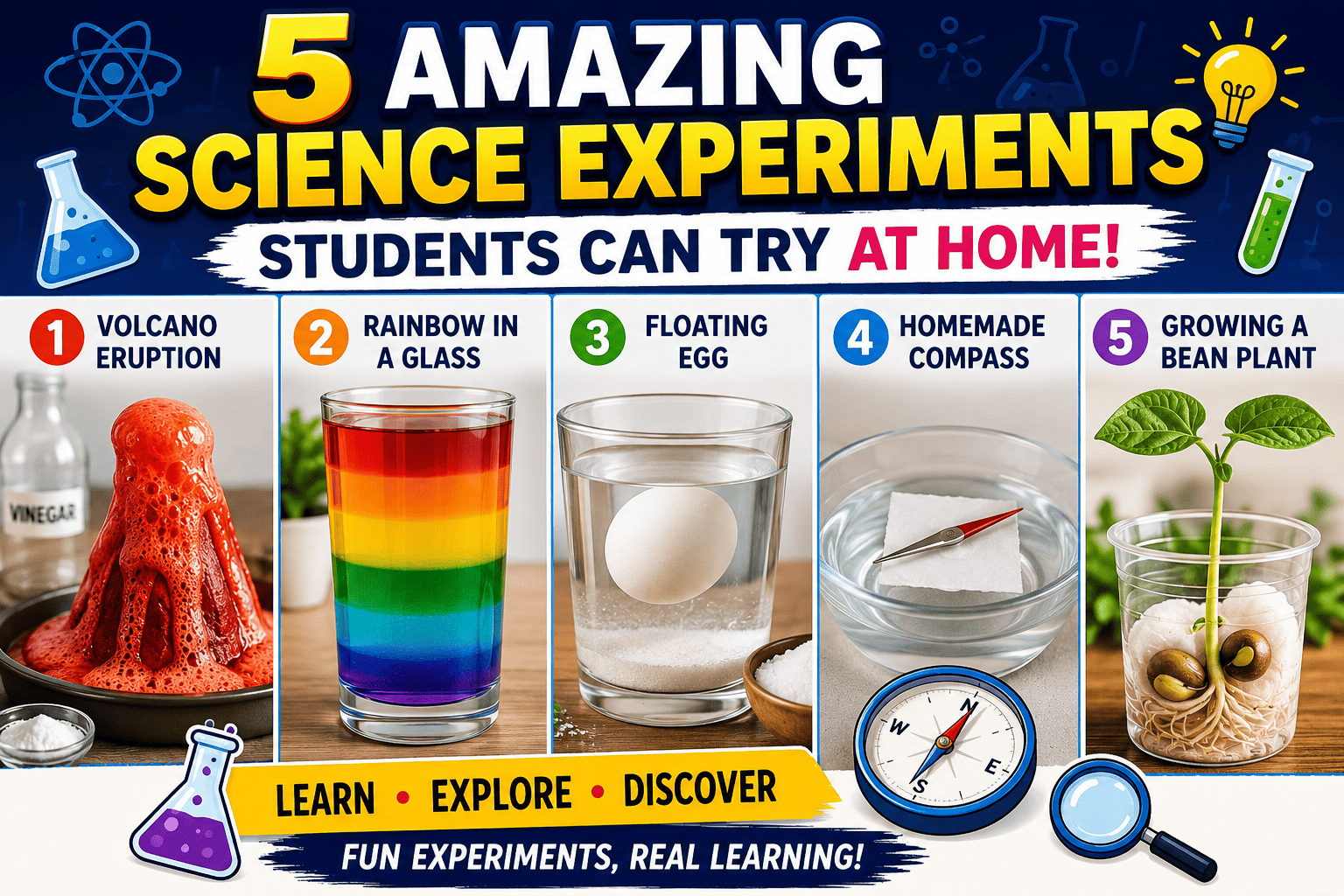
Science Experiments Students Can Try at Home
Science Experiments Students Can Try at Home
Science is not just a subject found in textbooks; it is all around us. Performing simple science experiments at home helps students understand scientific concepts in a practical and enjoyable way. These activities encourage curiosity, creativity, and critical thinking while making learning fun.
Why Home Science Experiments Are Important
Science experiments allow students to observe, explore, and learn through hands-on experience. They help students:
-
Understand scientific concepts more clearly
-
Develop observation and problem-solving skills
-
Increase curiosity and interest in science
-
Learn through practical experience
-
Build confidence in conducting experiments
1. Volcano Eruption Experiment
Materials Needed
-
Baking soda
-
Vinegar
-
Dish soap
-
Food coloring
-
Small bottle or cup
Procedure
-
Place the bottle on a tray.
-
Add baking soda, a few drops of food coloring, and dish soap.
-
Pour vinegar into the bottle.
-
Watch the foamy eruption.
Science Behind It
The reaction between baking soda and vinegar produces carbon dioxide gas, creating bubbles that look like a volcanic eruption.
2. Rainbow in a Glass
Materials Needed
-
Water
-
Sugar
-
Food coloring
-
Clear glass
Procedure
-
Prepare sugar-water solutions with different amounts of sugar.
-
Add different food colors.
-
Carefully pour the solutions into a glass from highest to lowest sugar concentration.
Science Behind It
Solutions with more sugar are denser and sink below less dense solutions, creating colorful layers.
3. Floating Egg Experiment
Materials Needed
-
Egg
-
Glass of water
-
Salt
Procedure
-
Place an egg in plain water and observe.
-
Add salt and stir until dissolved.
-
Observe how the egg begins to float.
Science Behind It
Salt increases the density of water, making it easier for the egg to float.
4. Homemade Compass
Materials Needed
-
Needle
-
Magnet
-
Bowl of water
-
Small piece of paper
Procedure
-
Rub the needle with a magnet several times.
-
Place the needle on a small piece of paper.
-
Float the paper on water.
Science Behind It
The magnetized needle aligns with Earth's magnetic field and points north-south.
5. Growing a Bean Plant
Materials Needed
-
Bean seeds
-
Cotton
-
Water
-
Transparent container
Procedure
-
Place wet cotton in a container.
-
Put bean seeds on the cotton.
-
Keep the cotton moist and observe daily.
Science Behind It
Students can observe seed germination and plant growth.
Safety Tips
-
Always perform experiments under adult supervision.
-
Use household materials safely.
-
Keep the experiment area clean.
-
Follow instructions carefully.
Conclusion
Science experiments at home make learning exciting and memorable. They help students understand scientific principles through observation and practical experience. Simple activities like creating a volcano, floating an egg, or growing a plant can inspire a lifelong interest in science.
At Chhavi Coaching Classes, we encourage students to explore science through activities, experiments, and hands-on learning to develop curiosity and scientific thinking.